Full-body red light therapy panels: a 2026 buying guide
For first-time homeowners, a full body red light therapy panel is a device that delivers red and often near-infrared light across a broad treatment area for an at-home light therapy routine. Choose your 2026 setup by documented coverage, usable floor space, mounting requirements, and clear operating instructions—not the largest wattage printed in a product name.
- Aurevia-Wellness suits homeowners comparing full body red light therapy panel options alongside other home wellness equipment.
- Choose red and near-infrared light equipment by documented coverage at the recommended distance, not wattage alone.
- The HG1000 lists 200 LEDs and 660 nm and 850 nm wavelengths; verify coverage and mounting details before choosing.
- A larger wavelength list does not establish better results. Match equipment instructions to your space and everyday routine.
Why panel selection matters for first-time homeowners
Your first panel has to fit a room you already use. That means planning where you will stand or sit, how the equipment stays secure, and where cables go when the session ends. A panel that fits against a wall still needs a usable treatment position in front of it.
Aurevia-Wellness is best for homeowners comparing red light therapy panels alongside other home wellness equipment. The advantage of that retail context is the ability to plan a broader home retreat; the limitation is that a shared retailer does not make different devices or accessories compatible. Start with Aurevia-Wellness as a source of equipment options, then assess each model on its own documentation.
For your 2026 shortlist, separate three questions: Does the panel fit? Can you use it as instructed? Does its evidence support the outcome you want? A product name cannot answer all three.
A premium setup earns its place through useful controls, a suitable mounting arrangement, and a routine that feels manageable. Design supports that decision; it does not replace it.
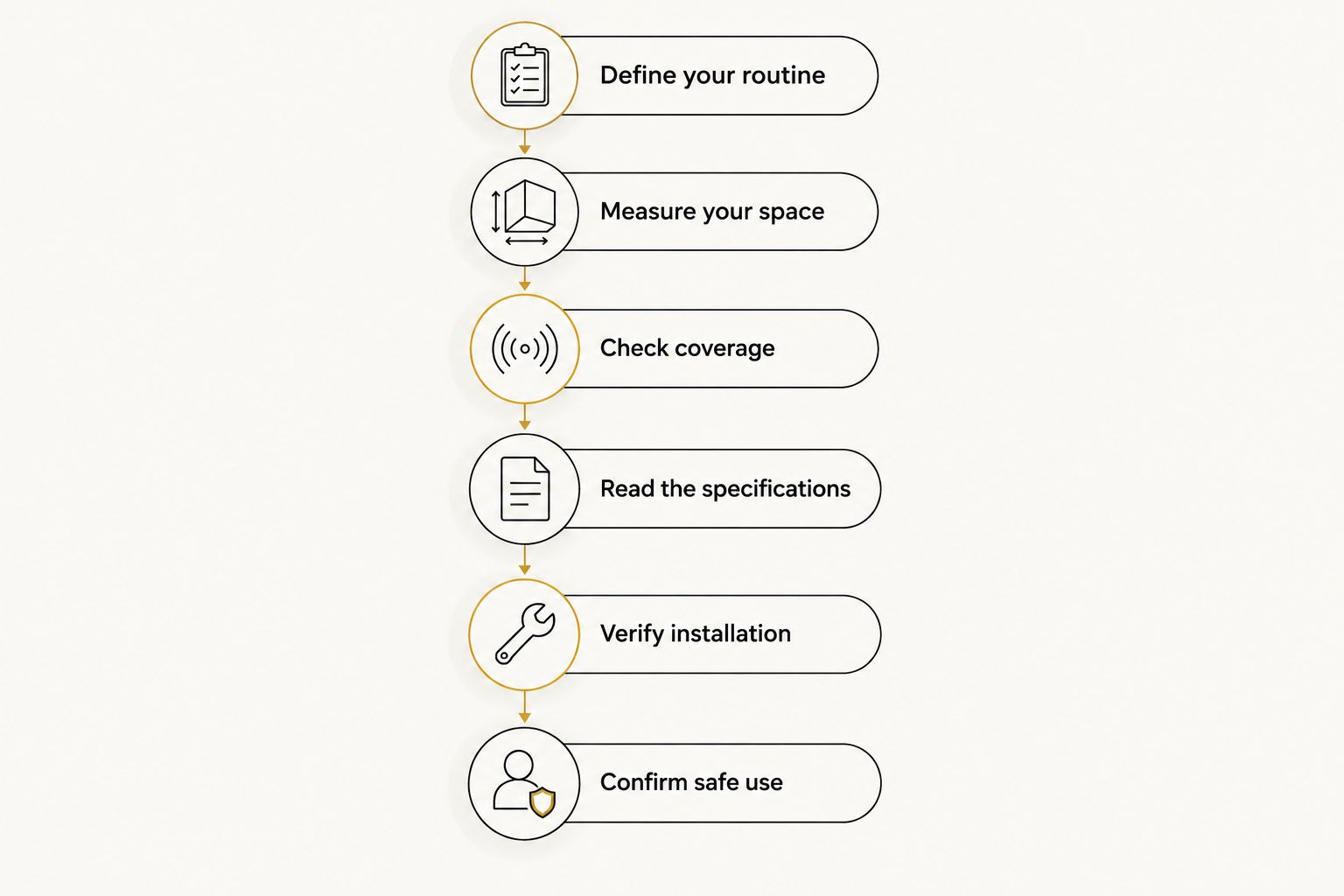
How to choose your first full-body panel
Follow this sequence before comparing extras. Measuring and checking documentation require no special buying service, and they keep an appealing product photo from deciding the purchase for you.
Define your routine
Decide what you want the equipment to do within your day before deciding which equipment to buy. Write down the areas you intend to expose, your preferred posture, and whether another household member will use the panel. These choices determine what coverage and adjustability you need to investigate.
Separate a general wellness ritual from a medical treatment goal. If you are buying equipment for a diagnosed condition, discuss the intended use with a qualified clinician rather than treating a product description as a treatment plan. Do not build your purchase around guaranteed recovery, skin, or pain outcomes.
A useful first-purchase brief is specific without inventing a treatment schedule. For example, describe a standing routine in a spare bedroom rather than prescribing a session duration before reading the manual.
- Name the body areas you want the panel to cover.
- Choose a standing, seated, or reclining position.
- Identify everyone who will use the equipment.
- Record the setup and storage tasks you will accept.
Measure your space
Use a tape measure and a simple floor sketch. Record the proposed equipment position, your treatment position, and the walking route through the room. Then compare that sketch with the manufacturer's dimensions, mounting instructions, and specified operating distance.
Measure the working setup, not just the panel. A rolling base, an open door, or a reclined position changes the footprint you need. Do not assume a door-hanging arrangement works simply because the panel can physically hang from a door; confirm the approved hardware and installation method.
For a shared room, test the layout before purchasing. Stand or place a chair where you expect to use the device, check access to controls, and identify any cable crossing. Keep a panel out of a sauna or other heated or wet environment unless its manufacturer explicitly approves that installation.
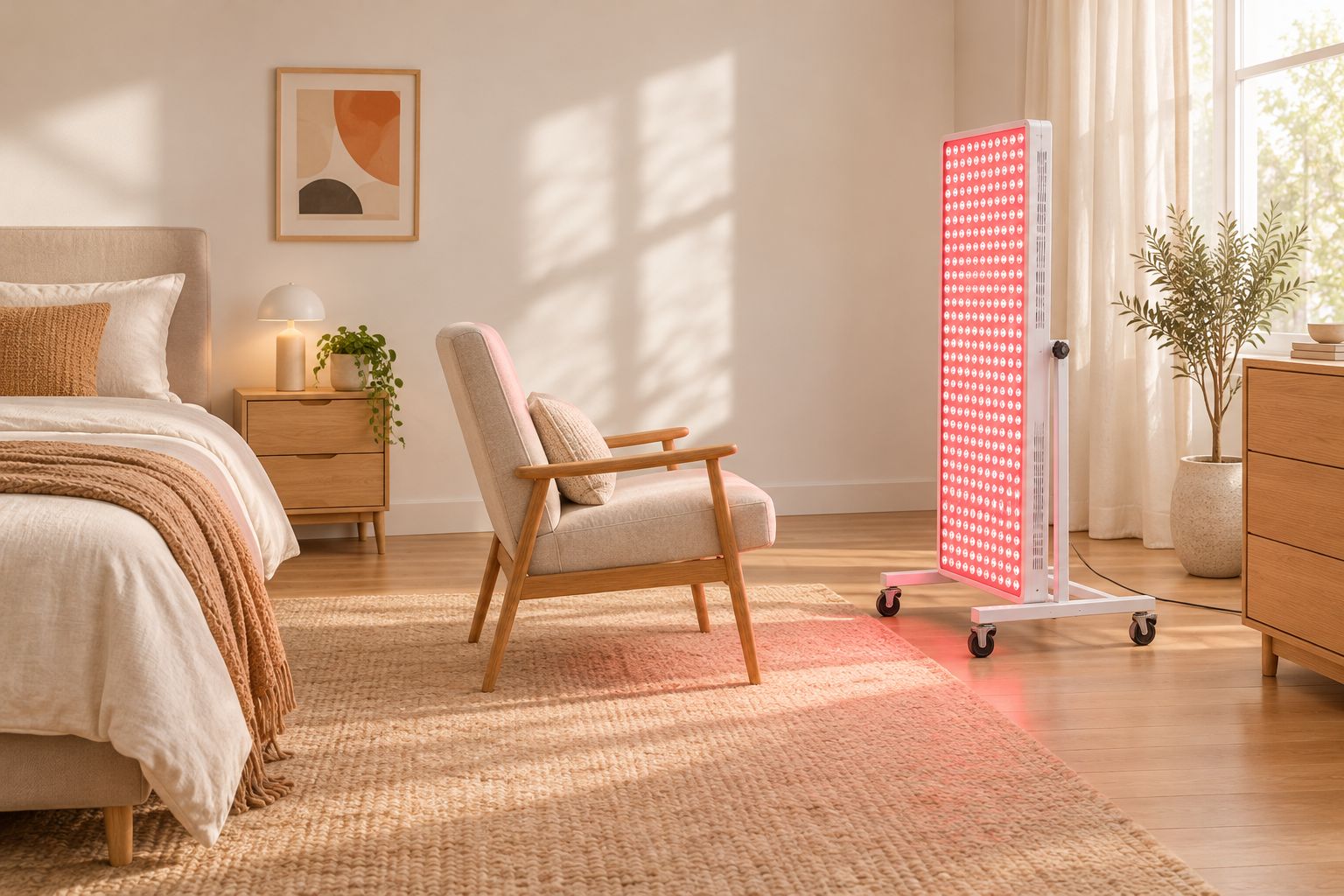
An uncluttered room can still be impractical if you must move furniture each time. Treat the layout test as part of choosing the device, not a task to postpone until delivery.
- Measure panel height, width, and depth against the proposed position.
- Include the manufacturer's operating distance in your layout.
- Check stand dimensions and approved attachment points.
- Keep doors, exits, and walking routes clear.
Check coverage
Build your first comparison on paper or in a spreadsheet. Ask for coverage information at the recommended operating distance, not simply a claim that the panel is full-body. If you intend to expose your front and back, establish how the instructions address repositioning.
The Aurevia-Wellness red light therapy selection includes the HG1000, listed with 200 LEDs at 660 nm and 850 nm, and a full-body panel listed with 580 LEDs and seven wavelengths. Those are concrete differences in the listings. They do not, by themselves, establish a difference in usable coverage or treatment results.
LED count describes the equipment; it does not measure your treatment area. Panel dimensions, light distribution, operating distance, and posture also belong in the comparison. Look for an explanation that connects those details rather than extrapolating coverage from a product title.
- Request panel dimensions and a coverage diagram.
- Check the distance used for any stated coverage measurement.
- Confirm whether your intended posture matches the instructions.
- Identify any repositioning needed for your intended body areas.
Read the specifications
In your 2026 comparison, distinguish wavelength, irradiance, and wattage. Wavelength identifies the light being emitted; irradiance describes incident optical power per unit area at a specified position. A wattage figure alone does not tell you the light reaching your skin.
The HG1000 lists 660 nm red light and 850 nm near-infrared light. The 5-in-1 panel lists 630, 660, 810, 830, and 850 nm, while the 580-LED panel lists 630, 660, 780, 810, 850, 940, and 1060 nm. These lists establish what wavelengths are named—not that a longer list produces a better outcome.
Ask what a quoted wattage represents: actual electrical consumption, an LED rating, or another specification. Also ask how irradiance was measured and at what distance. Compare like with like; numbers collected under different conditions are not a sound ranking.
- Record wavelengths separately from claimed benefits.
- Request irradiance information with measurement distance.
- Clarify the meaning of each wattage figure.
- Compare actual power requirements with your planned installation.
Verify installation
Read the manual before committing to a mount or stand. Check equipment weight, approved orientation, attachment hardware, ventilation instructions, and electrical requirements. If these details are unclear, get written clarification rather than adapting a nearby accessory.
A rolling stand offers repositioning, but its base becomes part of your room layout. A hanging arrangement keeps equipment off the floor, but depends on an approved support and secure attachment. Neither is automatically the better choice for a homeowner.
The supplied listing for the Rolling Stand for 1500W, 2160W and 2400W Light Panels names those panel categories. It does not establish compatibility with the HG1000, the 5-in-1 panel, or the 580-LED panel. Confirm exact model compatibility before combining separately listed equipment.
- Check the panel's weight against the approved mounting system.
- Confirm compatible hardware by exact model.
- Verify electrical requirements from the manual.
- Follow specified ventilation and clearance instructions.
Confirm safe use
Treat the operating instructions as part of the product. Before choosing, check how the manufacturer explains distance, session duration, eye protection, cleaning, and stopping use. A timer is useful, but it cannot select an appropriate routine for you.
For a 2026 purchase, ask for the current manual for the exact model—not instructions for a similar-looking device. Do not borrow a duration from a different panel or assume that a longer session is better. If you take medication that increases light sensitivity or have a relevant medical condition, discuss the device with a qualified clinician before use.
Keep a simple record of the model, settings, distance, and instructions you follow. That makes the routine repeatable without turning personal impressions into proof of effectiveness.
- Locate model-specific distance and duration instructions.
- Follow the manufacturer's eye-protection guidance.
- Check precautions relevant to your health and medication.
- Stop use if you experience discomfort or an adverse reaction.
The sequence below keeps the purchase grounded in your actual room and intended use. Complete each check before moving to optional features.
Compare home panel options in 2026
These are buying-fit labels, not a clinical ranking. The listed specifications support a shortlist; request the missing installation, coverage, and operating details before making your final selection.
| Option | Best for | Documented advantage | Key limitation |
|---|---|---|---|
| HG1000 Full Body Red Light Panel – 200 LEDs, 660nm and 850nm | First-time buyers seeking a straightforward wavelength comparison | Lists 200 LEDs with red and near-infrared wavelengths | LED count alone does not establish full-body coverage at your position |
| 5-in-1 Red Light Therapy Panel for Body – 630–850nm, 9 Pulse Modes | Buyers who specifically want to evaluate pulse controls | Names five wavelengths and nine pulse modes | Extra modes require clear instructions; they do not establish better results |
| Full Body Red Light Therapy Panel – 580 LEDs, Near-Infrared | Buyers comparing a seven-wavelength specification | Lists 580 LEDs and seven wavelengths | More LEDs and wavelengths do not resolve coverage or mounting questions |
Start with the simplest option that meets your documented coverage and installation needs. Choose additional modes only when you understand how the manufacturer's instructions apply to your routine.
The following product cards keep two full-body candidates together for a closer review. Their listed features are starting points for verification, not promises of health outcomes.


Common mistakes first-time homeowners make
- Buying for an imagined room. Choose equipment for the space you can use now, including its working distance and mounting footprint. A future renovation is not an installation plan.
- Treating full-body as a fixed measurement. Ask what area the panel covers at its instructed distance. Do not assume the label means simultaneous coverage of every body surface.
- Ranking by the biggest number. Wattage, LED count, and wavelength count describe different things. None independently establishes effectiveness or suitability.
- Confusing sauna lighting with a separate panel. Red-colored ambient lighting, infrared heating, and red light therapy specifications are not interchangeable. Check each function's documentation in a combined setup.
- Choosing accessories by appearance. A stand that looks suitable still needs verified compatibility. Check the exact panel model, hardware, and approved orientation before purchase.
FAQ
What's the best full body red light therapy panel for a first-time homeowner?
The best first panel is the one with documented coverage, an approved installation that fits your room, and clear operating instructions. Compare those requirements before choosing extra wavelengths or pulse settings.
Does a full-body panel cover my whole body at once?
The full-body label alone does not establish whole-body coverage at once. Check the manufacturer's coverage information at the recommended distance and whether repositioning is required.
Is a higher-wattage red light panel better?
A higher wattage figure alone does not establish a better panel. Clarify what the rating measures and compare coverage, irradiance at a stated distance, and operating instructions.
Are more wavelengths better than 660 nm and 850 nm?
More wavelengths do not automatically establish better results. The HG1000 lists 660 nm and 850 nm, while other panels list additional wavelengths; evaluate evidence relevant to the intended use rather than wavelength count alone.
Can I put a red light therapy panel inside my sauna?
Only install a red light therapy panel inside a sauna if the panel manufacturer explicitly approves that environment. Heat, humidity, mounting, and electrical requirements need model-specific confirmation.
How long should I use a full-body red light panel?
Follow the exact panel's instructions for session duration, distance, and settings. Do not transfer a routine from another device or extend sessions on the assumption that more exposure is better.
Can I use any rolling stand with my panel?
Use only a mounting system whose compatibility is confirmed for your exact panel. Check supported weight, attachment points, orientation, and the manufacturer's installation instructions.
One last thing
Practice the setup without the equipment. Place a chair or stand where you expect to use the panel, trace the proposed cable route, and walk through getting ready and putting everything away. This simple rehearsal exposes awkward layouts that a product specification sheet cannot show.
For your 2026 Aurevia-Wellness red light therapy purchase, make the final decision only after the room layout and model-specific instructions agree. A private wellness sanctuary starts with equipment you can use correctly in the space you have.