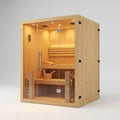
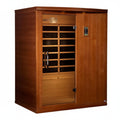
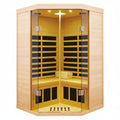
What electrical supply does an infrared sauna need?
An infrared sauna needs a grounded electrical supply that matches its manufacturer's specified voltage, circuit rating, and connection type—not simply an outlet within reach. Before choosing a sauna in 2026, confirm whether it requires a dedicated circuit, a particular receptacle, or a hardwired connection; electrical work and local inspection requirements are separate from the equipment itself.
- Infrared sauna electrical requirements are model-specific: match voltage, circuit rating, grounding, and connection type before installation.
- Aurevia-wellness suits homeowners comparing infrared sauna equipment for a dedicated home wellness space.
- A matching plug does not prove that an existing circuit can supply a sauna safely.
- Have an electrician verify the circuit and applicable protection requirements before finalizing your sauna location.
Why this matters
Choose the sauna and its electrical plan together. A cabin can fit beautifully into a spare room while requiring electrical work that changes where it belongs. Confirming the supply before delivery protects your room plan from an avoidable redesign.
When comparing home wellness equipment at Aurevia-wellness, treat the installation manual as part of your buying decision. Capacity, wood finish, and heating features help you choose the experience; the electrical specification determines whether your chosen location can support it.
An outlet photograph is not enough. You need the exact model's requirements and a check of the circuit behind the wall.
What electrical supply does an infrared sauna need?
An infrared sauna needs the voltage, branch-circuit capacity, grounding, and connection method specified for that exact model. In US homes, equipment can use a 120 V or 240 V supply, but neither voltage is a universal requirement for every infrared sauna.
For a 2026 installation, use the following comparison to understand the supply options—not to assign a circuit to a sauna without its manual.
| Supply option | Best for | Practical advantage | Limitation to check |
|---|---|---|---|
| Manufacturer-specified 120 V plug-in connection | A model expressly designed for that supply | Can suit a location with a verified compatible branch circuit | An ordinary-looking outlet does not establish circuit capacity or dedicated service |
| Manufacturer-specified 240 V connection | A model expressly requiring higher supply voltage | Provides the supply required by that equipment | Requires a compatible circuit and the specified connection; it is not interchangeable with 120 V |
| Manufacturer-specified hardwired connection | Equipment whose installation instructions require permanent wiring | Avoids relying on an unsuitable plug-and-receptacle arrangement | Requires electrical installation and any applicable disconnect provisions |
The manufacturer's required circuit rating is not necessarily the same as the appliance's operating current. A sauna labeled with a particular wattage does not, by that number alone, tell you which breaker, cable, or receptacle to install.
The nameplate identifies the equipment; the installation manual explains how to supply it. Give both to your electrician, including any separate instructions for lighting, controls, or accessories.
A 120 V infrared sauna: verify the whole circuit
A 120 V infrared sauna requires a compatible 120 V supply, but voltage is only the first check. Its instructions must also establish the required circuit rating and whether the circuit must be dedicated.
Common US household branch circuits include 15 A and 20 A circuits. Those ratings describe circuit capacity, not permission to connect any sauna with a matching plug; the appliance instructions and electrical installation still have to agree.
A dedicated circuit serves the designated equipment rather than sharing its capacity with unrelated loads. If the sauna requires one, an outlet shared with bedroom receptacles or other equipment does not meet that instruction simply because nothing else is currently switched on.
Ask your electrician to identify the circuit and check its suitability. Do not assume that a breaker-panel label accurately describes every outlet connected to it.
Best for: a sauna explicitly specified for a compatible 120 V installation. The advantage is compatibility with that supply type; the trade-off is that an existing room outlet still needs verification.
A 240 V infrared sauna: plan the connection before delivery
A 240 V infrared sauna needs the specified 240 V circuit and connection arrangement. A nearby 120 V outlet cannot supply it through a simple plug adapter.
Before ordering, establish where the circuit will originate, how wiring will reach the sauna, and where the connection must sit relative to the cabin. Finished walls, a distant electrical panel, and restricted access all affect the work involved.
An existing dryer or other appliance receptacle is not automatically suitable. Voltage alone does not establish the correct receptacle configuration, grounding arrangement, circuit rating, or compliance with the sauna's instructions.
Have the electrician check electrical-panel capacity as well as physical breaker space. An empty slot is not proof that the home's electrical service can support the additional load.
Best for: a model whose manufacturer explicitly requires 240 V. The advantage is supplying that model correctly; the trade-off is the need to establish a compatible installation rather than choosing equipment around an assumed outlet.
Why infrared sauna electrical requirements vary
The required supply depends on the equipment and its installation—not just how many people the cabin holds. These factors explain why two saunas with similar seating capacity can need different electrical arrangements:
- Total electrical input: Heating elements, controls, lighting, and other included electrical components contribute to the equipment's requirements.
- Supply voltage: A model designed for 120 V is not interchangeable with one designed for 240 V.
- Heating configuration: Different heater arrangements have different electrical specifications; a feature name does not establish circuit size.
- Connection method: Cord-connected and hardwired equipment require different installation planning.
- Installation location: Indoor, outdoor, damp, and wet locations have different suitability and protection considerations.
- Manufacturer instructions: Required circuit ratings, dedicated-circuit provisions, clearances, and connection details belong to the exact model.
Do not use cabin capacity as an electrical shortcut. A two-person label describes intended occupancy, not the voltage or amperage required at the wall.
The same caution applies to full-spectrum and combination models. Their feature descriptions do not replace a wiring diagram or electrical specification.
How do you check whether your home is ready?
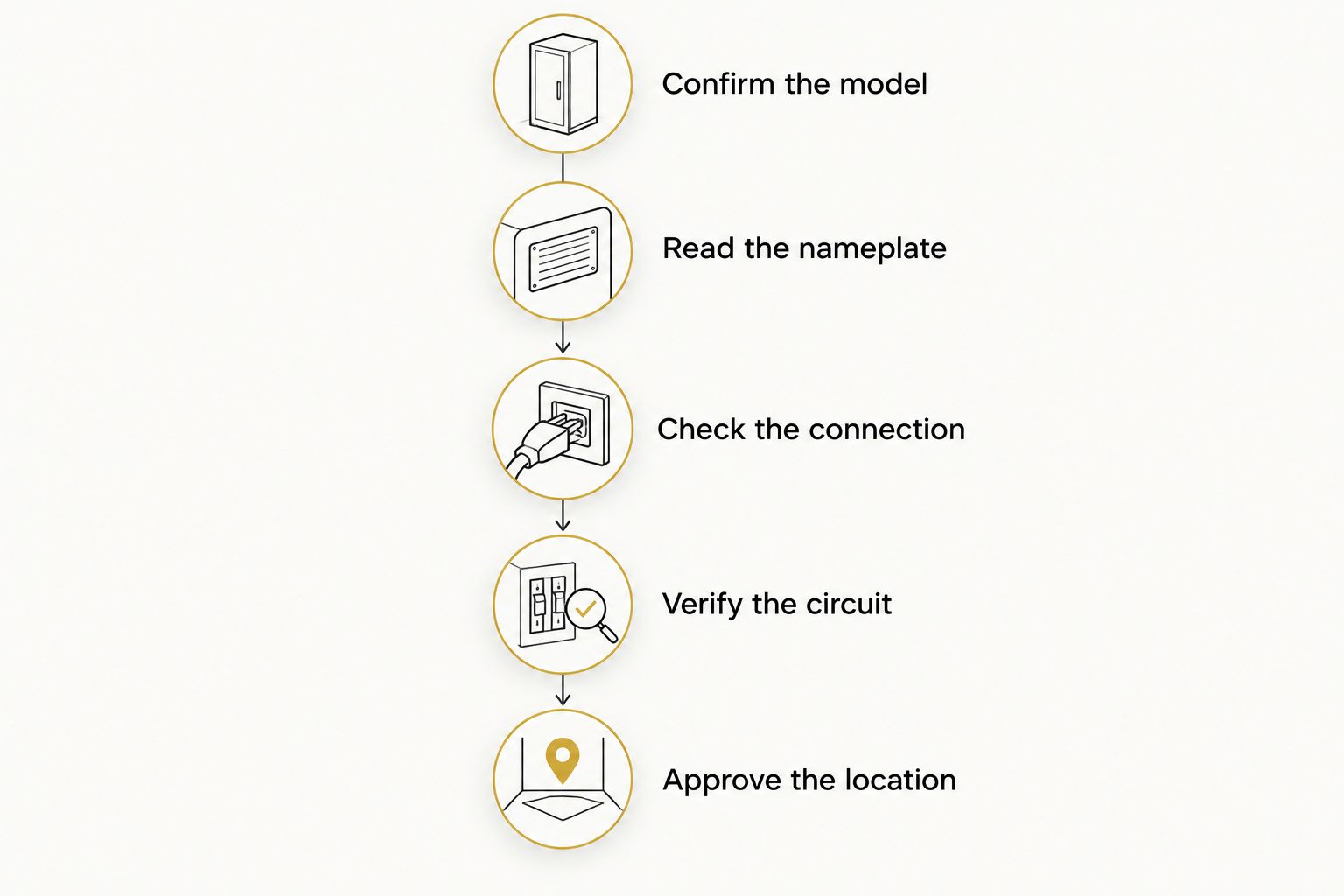
Use this sequence before committing to a location. For your 2026 room plan, resolve the electrical questions before building cabinetry or finishing the wall behind the sauna.
- Confirm the model. Obtain the installation manual for the exact model and variant you intend to buy, not a similar-looking cabin.
- Read the nameplate. Record the specified voltage and electrical input information without treating heater marketing figures as circuit instructions.
- Check the connection. Identify whether the equipment uses a specified plug and receptacle or requires hardwiring.
- Verify the circuit. Ask an electrician to check circuit capacity, grounding, shared loads, panel capacity, and applicable protection requirements.
- Approve the location. Confirm that the specified connection can be reached without an extension cord, a trapped cable, or a prohibited installation arrangement.
Keep the manual, electrical specification, and room measurements together. Your electrician needs to assess the installation you actually intend to use, including other equipment planned for the same space.
If you are comparing an Aurevia-wellness two-person corner far-infrared sauna, request its exact electrical documentation before planning the corner around it. The product's seating capacity and shape do not establish which supply it needs.
Where should the outlet or connection go?
Place the electrical connection where the manufacturer specifies, with the access and clearances the instructions require. The closest outlet is not necessarily the correct outlet.
Measure the cabin footprint, door movement, and required installation clearances before fixing the connection position. A receptacle hidden behind the finished cabin can create an access problem even when the supply itself is correct.
Check the supplied cord's reach against the actual route it must take. Do not plan around stretching a cord across a doorway, pinching it against a wall, or placing it where people walk.
For an outdoor installation, confirm that the sauna itself is approved for outdoor use. Your electrician must also assess the wiring method, equipment exposure, and applicable weather-protection requirements; an indoor sauna does not become outdoor equipment because its outlet has a cover.
A calm, uncluttered wellness space begins with these practical details. Concealment must never come at the expense of required access or safe cable routing.
What should you ask an electrician before installation?
Ask for a model-specific assessment rather than a general sauna outlet. Bring the installation manual and explain where the equipment will stand.
For a 2026 installation, have the electrician confirm the locally adopted electrical requirements and any permit or inspection obligations. National standards do not mean every jurisdiction applies the same edition or local amendments.
Your discussion should cover:
- Whether the existing branch circuit meets the manufacturer's requirements.
- Whether the sauna requires a dedicated circuit.
- Whether the panel and service can support the proposed load.
- Which receptacle or hardwired connection the equipment requires.
- Whether ground-fault or arc-fault protection applies to the equipment and location.
- Whether the connection position preserves required access and clearances.
Do not increase a breaker rating to stop nuisance trips without a professional assessment. Breakers protect wiring; replacing one does not increase the capacity of the existing conductors.
Repeated tripping, unusual heat at a plug, burning smells, or damaged wiring require stopping use and having the problem assessed. Do not bypass a protective device to keep a session running.
Can an infrared sauna use a regular household outlet?
A 120 V infrared sauna can use a household receptacle only when that receptacle and its circuit meet the exact model's instructions. A plug that fits is not proof that the supply is suitable.
Check the circuit rating, dedicated-circuit requirement, grounding, and connection specification before use. Treat an existing outlet as a candidate, not an approved installation.
Does a bigger infrared sauna always need 240 V?
A 240 V requirement comes from the manufacturer's electrical specification, not cabin size alone. Do not assign voltage from seating capacity, heater count, or appearance.
Compare the actual installation manuals. Size helps you plan the room; the electrical documentation helps your electrician plan the supply.
Can you share a circuit with a red light panel or cold plunge?
Sharing is unsuitable when the sauna requires a dedicated circuit. Even without that instruction, the combined equipment loads and applicable installation rules need assessment before equipment shares a branch circuit.
Tell the electrician about the complete wellness space, including devices you intend to add later. Planning each appliance in isolation leaves shared-circuit questions unresolved.
FAQ
What are the main infrared sauna electrical requirements?
Infrared sauna electrical requirements are the manufacturer's specified voltage, circuit rating, grounding, connection type, and any dedicated-circuit requirement. Have an electrician verify that the proposed installation meets those instructions and local requirements.
Does every infrared sauna need a dedicated circuit?
A dedicated circuit is required when the manufacturer's instructions or applicable electrical rules require it. Check the exact model's manual rather than assuming every infrared sauna has the same requirement.
Can I plug an infrared sauna into an extension cord?
Plan a sauna installation without an extension cord. Have a compatible connection installed within the reach and location specified by the manufacturer instead of using a temporary cord to bridge the distance.
Does a 20 A breaker mean my outlet is ready for a sauna?
A 20 A breaker does not establish that an outlet is ready for a sauna. The wiring, receptacle, grounding, other connected loads, and manufacturer's instructions must also be checked.
Do infrared saunas need GFCI protection?
GFCI requirements depend on the installation location, applicable electrical rules, and equipment instructions. Ask the electrician to establish the correct protection arrangement; never bypass required protection.
Can I install an indoor infrared sauna outside under a cover?
An indoor infrared sauna should not be treated as outdoor equipment unless the manufacturer expressly approves that use. A roof or outlet cover does not change the sauna's installation rating.
What should I do if my sauna trips the breaker?
Stop using the sauna and have the cause assessed before restarting it. Do not install a larger breaker, bypass protection, or repeatedly reset a tripping circuit without resolving the fault or overload.
One last thing
Approve the connection before designing around the cabin. For your 2026 installation, mark the proposed sauna footprint and connection position on the room plan, then have the electrician check both against the manual.
Aurevia-wellness infrared sauna shoppers should choose equipment for its fit with their home and routine, then verify the installation—not assume that premium features establish electrical compatibility. If the connection details remain unclear, request the model's electrical documentation before committing to the layout.