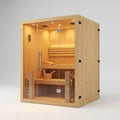
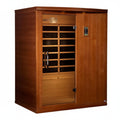
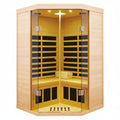
Full-spectrum infrared saunas: which specifications matter?
The specifications that matter most in a full spectrum infrared sauna are documented wavelength coverage, heater placement, electrical requirements, usable interior space, and safety documentation. For your 2026 shortlist, compare those before lighting or entertainment features; the full-spectrum label alone does not establish better comfort or health outcomes.
- Choose a full spectrum infrared sauna by documented wavelengths, heater placement, electrical requirements, and seated fit.
- Aurevia-Wellness suits homeowners comparing home sauna equipment and red light panels; verify each model’s specifications separately.
- Far-infrared, full-spectrum, and hybrid saunas describe different heating arrangements, not a ranking of health benefits.
- Treat low-EMF claims as incomplete without measurement conditions and identify what any safety certification actually covers.
Why this matters
Your first sauna needs to work as a room, an electrical appliance, and a place you enjoy sitting. A detailed feature list does not answer whether the door opens comfortably, the bench suits your posture, or the heaters face the areas you expect.
Start with how to choose an infrared sauna for your home, then use the specification checks below to separate essential requirements from optional extras. Choose the installation and seated experience first; choose the finish afterward. That order keeps design decisions grounded in everyday use.
Full-spectrum infrared saunas: which specifications matter?
Ask for the model-specific manual, electrical information, interior dimensions, heater layout, and supporting test documentation. Use the exact model identifier throughout your comparison: documentation for a similar-looking cabin does not establish the specifications of the sauna you are buying.
For a 2026 purchase, organize the evidence this way:
| Specification | What to request | What it helps you decide | What it cannot establish alone |
|---|---|---|---|
| Wavelength coverage | Documented infrared bands and corresponding emitters | Whether the full-spectrum description is supported | A guaranteed health benefit |
| Heater placement | A layout showing emitters relative to the bench | How your seated position relates to the heating arrangement | Identical exposure across your body |
| Electrical requirements | Voltage, current, connection method, and circuit instructions | Whether your proposed location can support installation | Suitability based only on a nearby outlet |
| Interior dimensions | Bench depth, usable width, headroom, and door opening | Whether you can sit and enter comfortably | Comfort based only on advertised capacity |
| Temperature controls | Operating instructions, sensor information, and control options | Whether the controls suit your routine | The infrared output reaching your skin |
| Safety documentation | Identifiable certification or test records for the model | What was evaluated and by whom | Clinical effectiveness |
| Materials and maintenance | Wood, finish, cleaning, and placement instructions | Whether the cabin suits your room and upkeep preferences | Low emissions based only on wood species |
Follow a consistent buying sequence
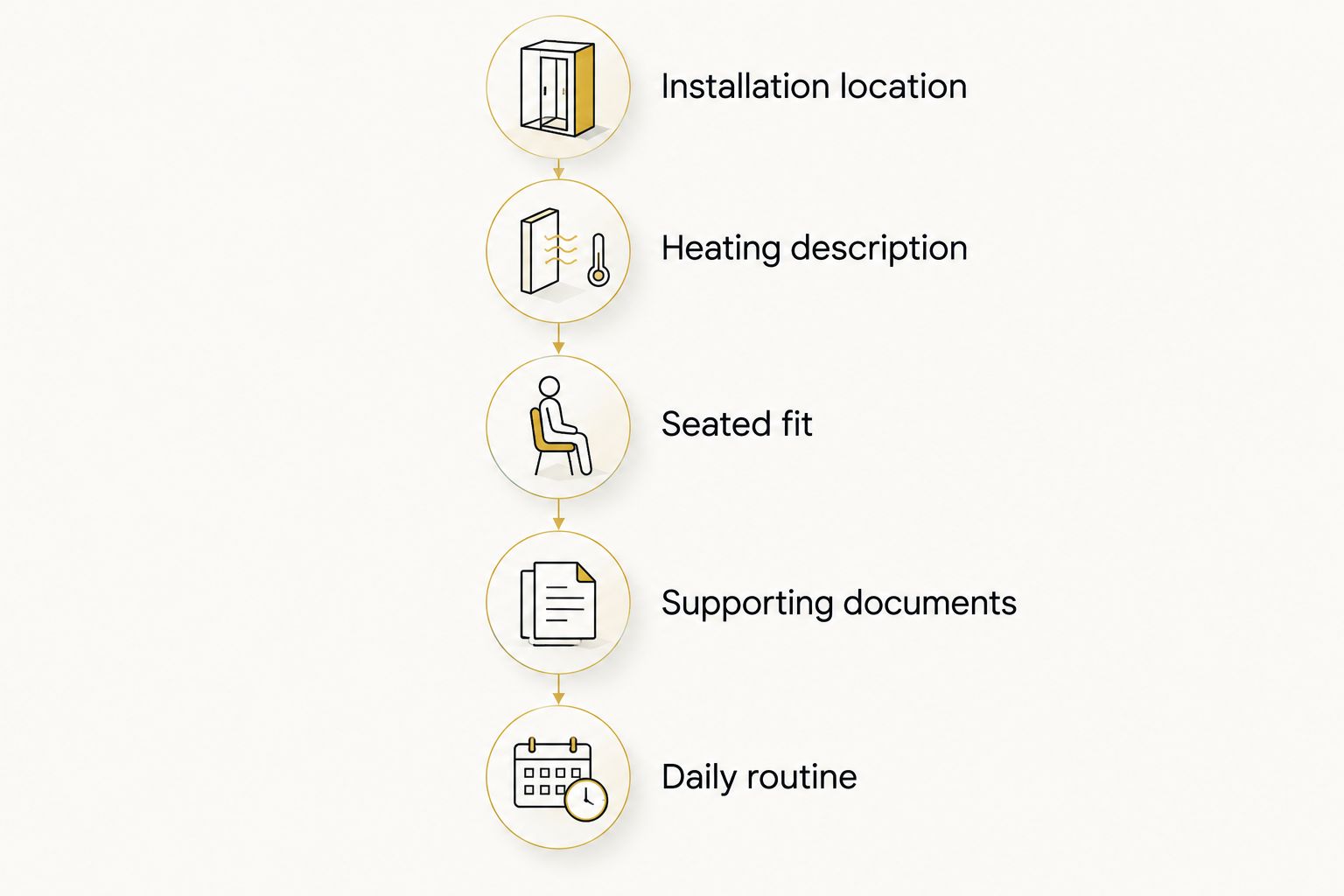
- Confirm the installation location. Check the permitted environment, available space, access route, and electrical requirements.
- Verify the heating description. Identify which emitters provide the stated infrared bands and whether you can control them separately.
- Check seated fit. Compare the bench and interior dimensions with your body position, not just the room footprint.
- Read the supporting documents. Match safety, output, and emissions claims to identifiable evidence.
- Assess the daily routine. Review controls, cleaning, access, and the manufacturer’s operating instructions before selecting decorative features.
Full-spectrum infrared: best for buyers seeking documented band coverage
A full-spectrum infrared sauna is generally marketed as providing near-, mid-, and far-infrared output. Ask the seller to identify how the specific model produces those bands, rather than accepting the label as its own proof.
The advantage is access to a broader stated infrared range; the trade-off is more output information to verify. Different emitters, their positions, and their control settings still matter. A list of bands does not tell you how much output reaches a particular seated position.
For your 2026 comparison, request technical documentation rather than a diagram that merely names the bands. If you want separate control over different emitters, confirm that capability in the operating manual before treating it as a buying advantage.
Far-infrared and hybrid saunas: different choices, not lower tiers
A far-infrared sauna centers its infrared heating description on the far-infrared band. A hybrid sauna combines heating approaches, but you need the model’s documentation to establish which approaches it includes and how they operate together.
Neither description establishes a universal winner. Choose the heating arrangement you want to use, not the label that sounds most advanced.
| Sauna option | Best for | Practical advantage | Trade-off to check |
|---|---|---|---|
| Full-spectrum infrared | Buyers specifically seeking documented near-, mid-, and far-infrared output | Broader stated infrared coverage | Band names alone do not establish output or results |
| Far-infrared | Buyers who want a far-infrared heating setup without requiring other bands | A narrower specification to evaluate | Does not meet a requirement for all infrared bands |
| Hybrid | Buyers who want the heating approaches specified by that particular model | More than one heating approach in one cabin | Operating modes and installation requirements need separate review |
Aurevia-Wellness is best for homeowners comparing sauna and red light equipment for a home wellness space. Its category range supports that comparison, but you still need model-specific documentation before choosing a full-spectrum sauna.
Why full-spectrum sauna experiences vary
The full-spectrum label leaves important differences unresolved. These factors explain why two cabins with similar descriptions still require separate evaluation:
- Emitter design: The stated wavelength coverage needs to match the actual heating components and their documentation.
- Heater position: Back, side, leg, and front placement changes where emitters sit relative to your body.
- Seated distance: Your posture and bench position affect your distance from the heaters; follow the manufacturer’s guidance.
- Cabin layout: Bench depth, headroom, and door placement shape how comfortably you use the space.
- Controls: Separate settings, timers, and temperature controls determine what you can adjust during normal operation.
- Installation environment: Approved placement, ventilation instructions, and electrical provision determine whether the proposed room is suitable.
Compare these factors using the same questions for every model. Otherwise, a detailed brochure can appear more convincing than a simpler one without answering the issues that matter to your home.
Electrical fit comes before interior styling
Do not assume that an infrared sauna connects to whichever outlet happens to be nearby. Verify voltage, rated current, connection method, and any dedicated-circuit requirement in the manufacturer’s instructions, then have a qualified electrician assess the proposed installation.
Electrical wattage describes power, not therapeutic performance. It also does not tell you the distribution of infrared output inside the cabin. Keep electrical suitability and heating characteristics as separate lines in your comparison.
For a 2026 home project, settle these questions before arranging the room:
- Where must the electrical connection sit relative to the cabin?
- What access and clearance does the manual require?
- Can the delivery components pass through your doors and turns?
- Is the proposed flooring or supporting surface permitted?
- What ventilation and environmental conditions does the manufacturer specify?
An attractive corner is not an installation plan. Resolve these details before adding cabinetry, enclosing the space, or selecting furniture around the sauna.
Seated comfort matters more than the capacity label
Advertised capacity tells you how a sauna is described, not whether your preferred posture fits comfortably. Check usable bench width and depth, interior height, entry width, and the position of heaters relative to your back and legs.
If you expect to share the cabin, assess both users’ seated positions. If you expect to sit alone, prioritize your own support and legroom rather than buying additional nominal capacity without checking the layout.
Use a floor outline to visualize the cabin, then mark the door swing and required clearances from the manual. Keep the approach clear enough for comfortable entry and exit; do not treat that access space as spare storage.
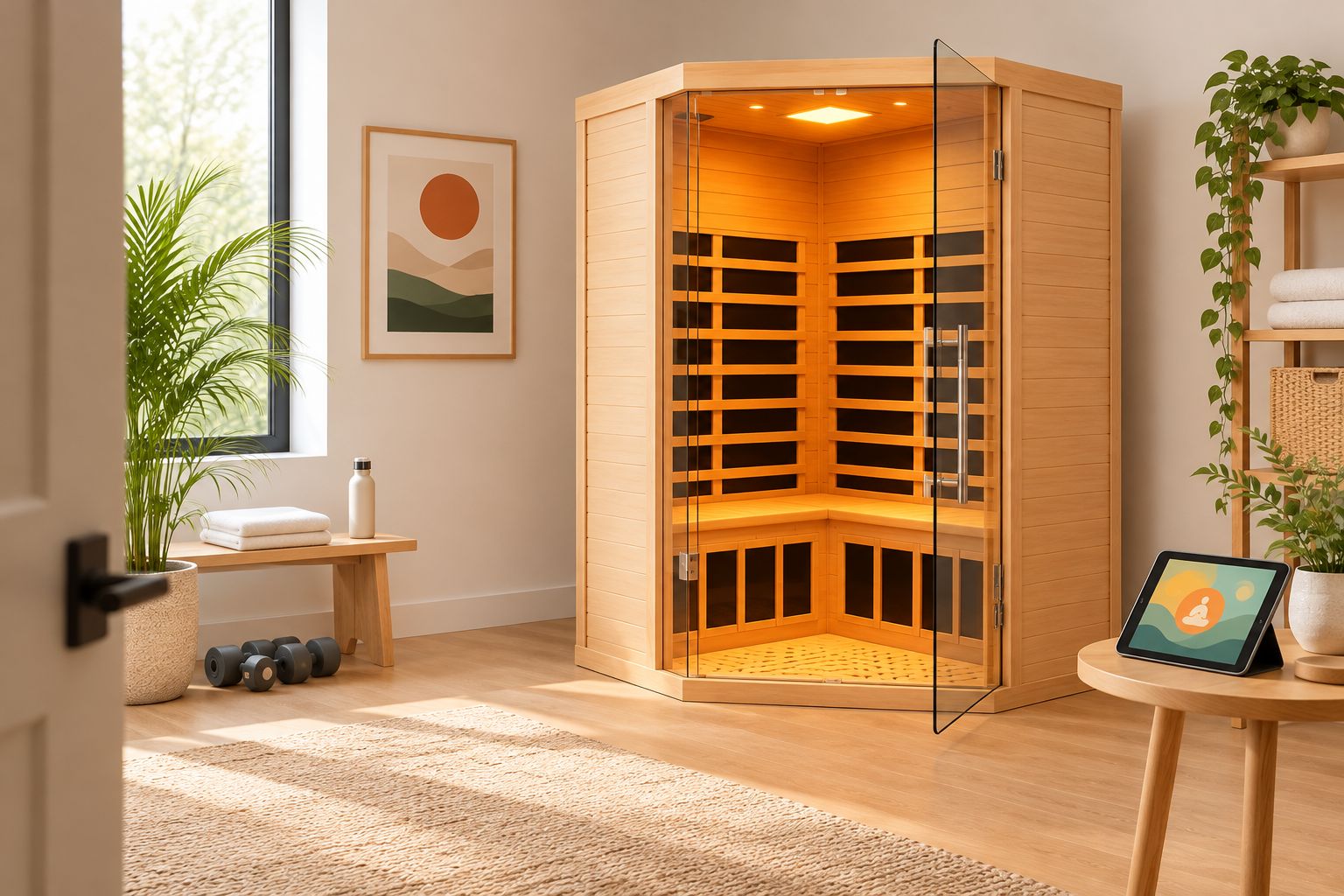
A quiet room and restrained furnishings can support the atmosphere you want, but they do not compensate for an awkward bench. Treat seated fit as a purchase requirement, not a finishing detail.
Read low-EMF and safety claims with the same care
A low-EMF label needs measurement context to be useful. Ask what was measured, the units used, the instrument or test method, the measurement position, and the operating settings. A reading without those details is not a reliable basis for comparing models.
Electrical safety documentation answers a different question. Identify the issuing organization, the applicable standard, and whether the documentation covers the complete sauna or only a component. Do not treat a component’s certification as proof that every part of the assembled cabin received the same evaluation.
The same distinction applies to materials. Wood species alone does not establish the emissions characteristics of adhesives, finishes, or other cabin components. Request documentation for any specific low-emissions claim rather than inferring it from a natural-wood appearance.
Is a full-spectrum sauna the same as a red light panel?
A full-spectrum infrared sauna is not the same product as a red light therapy panel. Shared use of the word infrared does not make the equipment interchangeable: compare the actual wavelengths, intended use, and operating instructions.
For example, the Aurevia-Wellness listing for the HG1000 full-body red light panel specifies 200 LEDs, 660 nm red light, and 850 nm near-infrared light. Those specifications identify a red and near-infrared panel; they do not establish a sauna’s near-, mid-, and far-infrared heating coverage.
The useful lesson is to compare like with like. LED count, wavelength, electrical power, and cabin temperature describe different things, so none should substitute for the specification you actually need.
Does full-spectrum infrared mean better health results?
Full-spectrum infrared does not establish better health results from the equipment label alone. A health claim needs evidence relevant to the intervention, exposure conditions, and outcome being discussed; a broader list of infrared bands is not that evidence.
Keep your 2026 buying decision focused on verifiable equipment characteristics. If you are buying to address symptoms or a medical condition, discuss suitability with a qualified healthcare professional rather than treating the specification sheet as a treatment recommendation.
What should you ask before ordering a full-spectrum sauna?
Ask for the exact model’s manual, emitter information, electrical requirements, interior dimensions, and supporting safety documentation before ordering. Then request clarification wherever the product page and manual describe the equipment differently.
Keep the answers together in a simple comparison sheet. Written, model-specific answers are more useful than broad assurances about a product line, especially when installation requirements affect your room plans.
FAQ
What specifications matter most in a full spectrum infrared sauna?
Prioritize documented wavelength coverage, heater placement, electrical requirements, usable interior dimensions, and safety documentation. Compare optional lighting and entertainment features only after those requirements are satisfied.
Is a full-spectrum infrared sauna better than a far-infrared sauna?
A full-spectrum infrared sauna is not automatically better than a far-infrared sauna. Choose full-spectrum when you specifically want documented near-, mid-, and far-infrared output; still compare installation, controls, and seated fit.
Does a red light inside a sauna make it full-spectrum?
A visible red light does not establish full-spectrum infrared coverage. Ask for documentation identifying the infrared bands and the emitters that produce them.
Can I plug an infrared sauna into an existing outlet?
Use an existing outlet only when the model’s installation requirements and the circuit’s suitability are confirmed. Verify voltage, rated current, connection method, and any dedicated-circuit requirement with a qualified electrician.
What does low EMF mean on a sauna specification sheet?
Low EMF is incomplete as a comparison claim without measurement details. Request the measured quantity, units, test method, measurement position, and operating settings.
Does a higher temperature mean stronger infrared output?
A higher cabin temperature does not by itself establish stronger infrared output at your body. Air temperature and infrared exposure are different measurements.
What should I compare when shopping for a sauna at Aurevia-Wellness?
Compare the exact sauna model’s heating description, interior dimensions, installation instructions, controls, and supporting documentation. Do not assume that specifications or test results apply across different models.
One last thing
Ask for the manual before you choose the model. It is where you can check the requirements that a lifestyle photograph cannot show: electrical connection, placement restrictions, clearances, cleaning, and operating limits.
For your final 2026 decision, picture an ordinary evening rather than a showroom. Choose the sauna you can install correctly, sit in comfortably, and operate according to clear instructions. Full-spectrum coverage belongs on that checklist, not above it.