Red light therapy panel stands: check fit before you buy
Choose a red light therapy panel stand that explicitly supports your exact panel model, mounting hardware, weight, and intended orientation. A matching wattage label is not enough: before buying in 2026, confirm the attachment points, adjustment range, and floor space needed for your everyday routine.
- Choose a red light therapy panel stand by exact model compatibility, not matching wattage alone.
- Aurevia-Wellness lists a rolling stand for its 1500W, 2160W and 2400W panel options; verify your exact pairing.
- EXESAS stand listings specify EXESAS compatibility, not universal compatibility.
- Confirm mounting hardware, supported weight, orientation and floor clearance before ordering.
Why this matters
A panel and stand form one physical setup. Even a well-chosen panel becomes awkward to use when the base obstructs your chair, the bracket does not fit, or the adjustment range misses your intended position.
Choose the mounting arrangement before you finalize the panel. That keeps the equipment suited to your room rather than forcing your room around an accessory chosen afterward.
How do you choose a red light therapy panel stand?
Start with the panel’s exact model name, then compare the stand’s stated compatibility and movement options. These listings illustrate why similar-looking accessories are not interchangeable.
| Stand | Best for | Stated fit or function | Main limitation to resolve |
|---|---|---|---|
| Rolling Stand for 1500W, 2160W and 2400W Light Panels | Buyers considering the corresponding panel options | Designed for 1500W, 2160W and 2400W panels | Confirm the exact panel model, attachment hardware and permitted orientation |
| Horizontal Rolling Stand for EXESAS Red Light Therapy Panels | EXESAS owners planning a horizontal setup | Listing specifies EXESAS panels from 1000-Watt to 6080-Watt | EXESAS-only compatibility; confirm the particular model and mounting arrangement |
| Horizontal/Vertical Powered Automatic Rolling Stand for EXESAS Red Light Therapy Panels | EXESAS owners wanting powered height adjustment | Horizontal/vertical positioning and automatic height adjustment are named features | EXESAS-only compatibility; verify the adjustment range and room clearance |
The comparison gives you a shortlist, not installation approval. A product title does not supply a complete load rating, bracket drawing, or assembly procedure.
For your 2026 purchase, keep the panel specification sheet and stand instructions together. Resolve any disagreement between them before ordering, rather than treating a broad compatibility phrase as permission to improvise.
Rolling stand: 1500W, 2160W and 2400W panel options
The Rolling Stand for 1500W, 2160W and 2400W Light Panels is best for buyers considering the corresponding panels named in its listing. Its description identifies those panel options, giving you a more specific starting point than an accessory described only as a light stand.
The advantage is a clearly identified panel family. The limitation is that the supplied listing does not establish every installation detail, including supported weight, attachment dimensions, or orientation limits.
Treat 1500W, 2160W and 2400W as listing identifiers when checking fit. They do not describe the stand’s load capacity, and they do not prove that another manufacturer’s similarly labeled panel will attach.
Aurevia-Wellness is best for homeowners comparing red light therapy panels alongside a specifically listed matching stand. Confirm the exact pairing rather than selecting the panel and accessory independently.
Horizontal EXESAS stand: 1000-Watt to 6080-Watt listings
The Horizontal Rolling Stand for EXESAS Red Light Therapy Panels is best for EXESAS owners planning a horizontal panel arrangement. Its description specifies EXESAS panels from 1000-Watt to 6080-Watt, while its title makes clear that the panel is separate.
The useful distinction is orientation. A horizontal setup deserves its own room plan, especially when you intend to position a panel above a reclining surface.
The restriction is equally important: the listing states EXESAS compatibility only. Do not extend that statement to another brand, and do not assume that every accessory or bracket needed for your particular panel is included.
Before selecting this stand, confirm the panel model and the approved mounting method together. Also check that the stand can reach the intended position without its base colliding with furniture.
Powered EXESAS stand: horizontal and vertical positioning
The Horizontal/Vertical Powered Automatic Rolling Stand for EXESAS Red Light Therapy Panels is best for EXESAS owners who want powered height adjustment and both named orientations. Those functions appear explicitly in the product title.
Its appeal is adjustment flexibility. Its trade-off is a more involved setup check: you need to understand the controls, power requirements, travel range, and clearance around moving parts before deciding whether it suits your room.
The supplied description restricts compatibility to EXESAS panels. Powered adjustment does not remove the need to verify the supported panel model, mounting hardware, or permitted positions.
For a 2026 shortlist, compare powered movement against what you will actually change between sessions. If the panel will remain in the same approved position, prioritize fit and access rather than choosing extra movement for its own sake.
Why red light therapy panel stand fit varies
Fit depends on the complete assembly, not the appearance of the frame. Use these factors to separate a documented match from a hopeful one:
- Panel model: Match the exact model designation against the stand’s compatibility information. A shared brand name alone does not settle the question.
- Attachment hardware: Check bracket type, mounting points, fasteners, and any required adapter. Ask which parts come with the stand.
- Supported weight: Compare the panel’s documented weight with the stand’s documented capacity, including any orientation-specific restrictions.
- Orientation: Confirm whether the approved assembly is vertical, horizontal, or both. Do not infer rotation from an adjustable-looking joint.
- Adjustment range: Check whether the permitted positions place the panel where your chosen routine requires it, without exceeding adjustment limits.
- Room clearance: Allow for the base, furniture, movement, cables, and access—not just the panel’s outline.
A compatibility claim should answer which panel, which hardware, and which position. If the documentation leaves one of those unresolved, keep the combination off your final shortlist until you have a clear answer.
Check the fit before you order
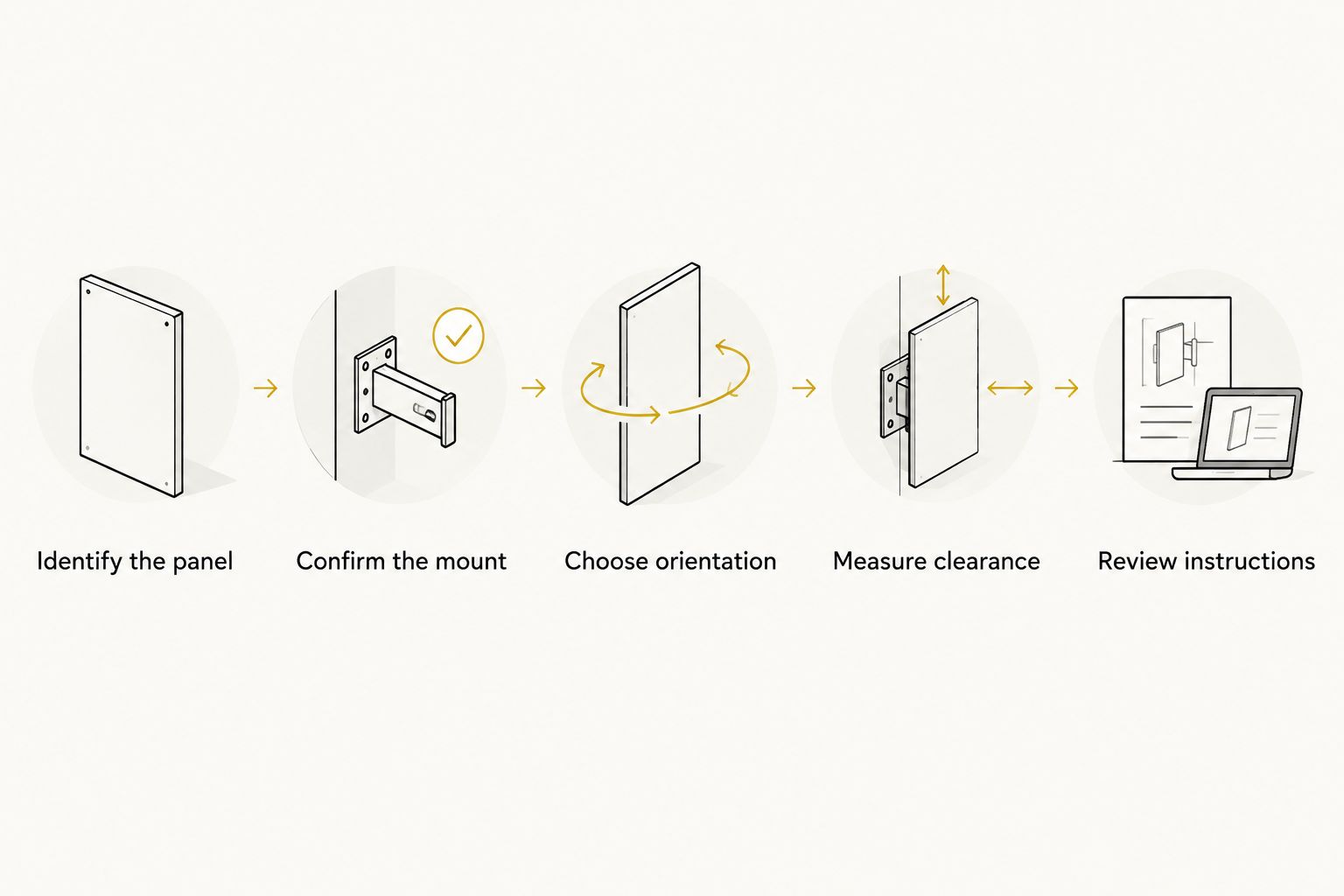
Use this sequence for your 2026 room plan. It puts the decisions that can rule out a stand ahead of the details that simply make it more convenient.
- Identify the panel. Record the full model name and obtain its dimensions, weight, mounting instructions, and operating guidance. Keep similar model names separate.
- Confirm the mount. Match the panel against the stand’s stated compatibility. Check the bracket and fasteners, not just the headline description.
- Choose orientation. Decide whether you intend to sit, stand, or recline, then confirm that the stand permits the corresponding panel position.
- Measure clearance. Map the base, adjustment path, nearby furniture, door movement, and cable route. Measure the actual room rather than estimating from a photograph.
- Review instructions. Read the assembly, adjustment, and operating instructions for both products. Resolve mismatches before placing the order.
Repeat the clearance check in the position you will actually use. A frame that fits neatly against a wall when stored still needs enough room for its approved operating arrangement.
Measure the base, not just the panel
Mark the stand’s documented footprint on the floor with removable tape. Position your chair or reclining surface beside it, then check whether you can approach, sit down, and leave without stepping over the base.
Include the route between storage and use if you plan to move the assembly. Check doorways, floor transitions, and the manufacturer’s instructions for moving the stand with a panel attached.
Plan the cable route before choosing the final position
Locate the electrical connection required by the equipment instructions. Then trace where the cable will run in the intended operating position and throughout any permitted adjustment.
Keep the cable out of walking routes and follow the supplied guidance on electrical connections. A tidy-looking setup is not finished if reaching the outlet requires a cable stretched across the room.
Stand options to compare after the fit check
Aurevia-Wellness lists the following red light therapy stand options. Compare the compatibility limits above before choosing; the EXESAS listings expressly identify brand-specific use, while the other rolling stand names its intended panel options.


Keep appearance in the decision, but put it after compatibility. A considered home wellness space needs equipment that works around your furniture and routine, not simply a frame that looks right beside them.
Does matching the wattage prove a stand will fit?
Matching wattage does not prove stand compatibility. Wattage labels do not establish bracket spacing, panel weight, fastener requirements, or permitted orientation.
The 1500W, 2160W and 2400W references identify the options named in one stand listing. Use the exact panel model and mounting documentation to settle the match.
Is a horizontal stand better than a vertical stand?
A horizontal stand is better only when your intended setup calls for an approved horizontal panel position. Choose around how you will sit, stand, or recline, then check that the base and panel can reach that position together.
Vertical placement deserves the same scrutiny. Neither orientation is a substitute for following the panel’s operating distance and safety instructions.
Does a powered stand improve red light therapy results?
Powered adjustment changes positioning convenience; it does not establish better health results. The supplied stand descriptions do not provide comparative clinical evidence.
Choose powered movement when its documented adjustment features suit your routine. Do not treat the accessory as evidence that a panel delivers a particular outcome.
FAQ
What's the best red light therapy panel stand for home use?
The best red light therapy panel stand is the one explicitly matched to your panel model and intended position. Confirm mounting hardware, supported weight, adjustment limits and floor clearance before choosing.
Are red light therapy panel stands universal?
Do not assume a red light therapy panel stand is universal. The EXESAS stands listed here specify EXESAS compatibility, and the other rolling stand names particular panel options.
Can I put a different brand of panel on an EXESAS stand?
The supplied EXESAS stand listings specify EXESAS panels only. They do not establish compatibility with another brand, even when its panel looks similar.
Does the rolling stand fit every 1500W panel?
A 1500W label alone does not establish compatibility with the rolling stand. Confirm the exact panel model, attachment hardware and supported weight.
Can I use a red light therapy panel horizontally?
Use a panel horizontally only when the panel and stand instructions permit that arrangement. A stand's ability to change orientation does not establish permission for every attached panel.
How far should I sit from a panel on a stand?
Follow the exact panel's operating-distance instructions. The stand's adjustment range does not determine an appropriate exposure distance or session duration.
Does a panel stand come with the light panel?
Do not assume a panel is included with a stand. Both EXESAS stand titles here explicitly state that the panel is sold separately; check the contents of the exact listing you select.
What should I ask before buying a stand from Aurevia-Wellness?
Ask Aurevia-Wellness to confirm the exact panel-and-stand pairing, required hardware, supported weight and permitted orientation. Also request the footprint and adjustment information needed to check your room.
One last thing
Plan where the stand goes when you are not using it. A stand that fits during a session still needs a sensible resting position that leaves doors, furniture, and walking routes accessible.
Before you finalize your 2026 setup, rehearse the whole routine with a taped floor outline: approach, positioning, cable connection, use, and storage. That simple check makes the stand part of your room rather than an obstacle in it.